
Find Marion County Traffic Court Records
Marion County traffic court records are handled by the Clerk of the Circuit Court in Ocala. This Central Florida county has about 380,000 residents and covers a wide area that includes several major highways. If you got a ticket anywhere in Marion County, the clerk's office processes your case and keeps the records. You can search for traffic citations, make payments, and get case updates through the clerk's online tools or by contacting their office directly. Understanding how to access Marion County traffic court records makes it easier to take care of open cases and check on past ones.
Marion County Quick Facts
Marion County Clerk of Court Traffic Office
The Marion County Clerk of the Circuit Court is the central office for all traffic citation work in the county. Situated in Ocala, the clerk processes new tickets, collects fines, sets court dates, and stores records. Every traffic stop in Marion County goes through this same office, whether it happened on I-75, US 441, or a back road near Dunnellon or Belleview. The volume of citations is considerable because of the county's size and the amount of through-traffic on its highways.
Reach the Marion County Clerk at 352-620-3368. Send mail to PO Box 907, Ocala, FL 34478. The clerk's website is marioncountyclerk.org and has links to court services, search tools, and contact details. If you need to visit in person, the courthouse is in downtown Ocala. Having your citation number handy makes things go quicker.
| Office | Marion County Clerk of the Circuit Court |
|---|---|
| Mailing Address | PO Box 907, Ocala, FL 34478 |
| Phone | 352-620-3368 |
| Website | Marion County Clerk of Court |
Note: Marion County is one of the largest counties in Florida by land area, so citations can come from a wide range of agencies and patrol zones.
Searching Traffic Records in Marion County
The Marion County Clerk offers tools for looking up traffic court records. Start at marioncountyclerk.org to find links to case search portals and payment systems. The Florida Courts E-Filing Portal provides another way to search Marion County cases by name or case number. Between the local clerk's website and the statewide tools, most Marion County traffic court records are accessible from a computer or phone.
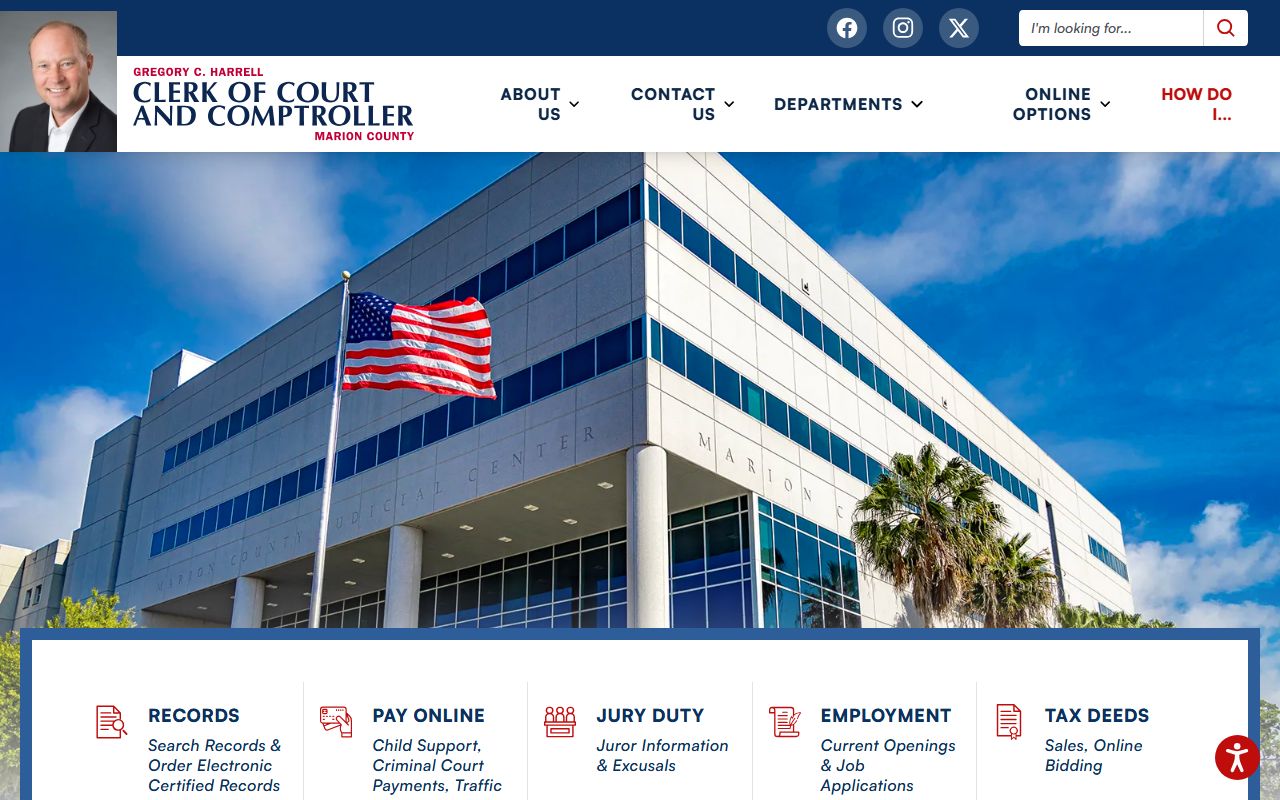
The Marion County Clerk of Court website is your starting point for looking up traffic citations and court case information in the Ocala area.
For records that do not show up online, call the clerk's office. Staff can search by citation number, driver name, or date of violation. They deal with Marion County traffic court records all day and can usually pull up your case quickly. In-person visits work too, especially if you need certified copies or want to review original documents. The Florida Clerks of Court Operations Corporation helps all 67 clerks maintain consistent standards, and Marion County is part of that statewide system.
Traffic Ticket Options in Marion County
Florida gives you 30 days from the date of a citation to respond. This rule comes from Chapter 316 of the Florida Statutes, which sets uniform traffic laws across every Florida county. You have three main choices when it comes to a Marion County traffic ticket. Each one has different consequences for your driving record and your wallet.
Paying the fine is the fastest route. It counts as a guilty plea. The Florida Department of Highway Safety and Motor Vehicles adds points to your driving record based on the violation type. To pay a Marion County traffic citation, use the PayFLClerk portal online. You can also mail a check to the clerk's PO Box or pay at the Ocala courthouse in person. Online payment takes just a few minutes and gives you immediate confirmation.
Traffic school is the second path. You plead no contest, and the court withholds adjudication. That means no points on your license. You still pay the fine, but the long-term damage to your record is far less. You get extra time to finish a state-approved course after the clerk processes your election. However, traffic school is not available for every violation. Under Florida Statute 318.18, some infractions carry mandatory penalties that cannot be reduced. The Marion County Clerk can confirm whether your citation qualifies.
Contesting the ticket is the third option. File a not guilty plea within 30 days. The Marion County court schedules a hearing. You show up, present your case, and a judge decides. If you win, the citation is dismissed. If you lose, you pay the fine and court costs. Each of these paths creates records in the Marion County traffic court system that stay on file permanently.
Fines and Collections in Marion County
Fine amounts for Marion County traffic citations vary by violation. Non-moving violations are the cheapest. Speeding, running red lights, and reckless driving cost more. Late fees get added once the 30-day window closes. The clerk adds these automatically. There is no grace period beyond the original 30 days in Marion County.
Fines left unpaid for more than 90 days go to a collection agency under Florida Statute 28.246. The collection agency can charge up to 40% on top of the original amount owed. That turns a $175 Marion County traffic fine into $245. Your license also gets suspended through FLHSMV. Reinstatement requires paying the full balance plus extra fees. The cheapest option is always to deal with your Marion County traffic citation before it snowballs. If you have an old unpaid ticket, contact the clerk at 352-620-3368 to find out where your case stands.
Public Records Law and Marion County
Marion County traffic court records are public. Chapter 119 of the Florida Statutes makes all state, county, and municipal records available for inspection. Anyone can look up a traffic case in Marion County. You do not need to be the person on the citation. The clerk must provide access when asked.
Privacy protections still apply to certain data. Social security numbers, bank accounts, and similar sensitive details are taken out before records are shared. But the facts of a Marion County traffic case, such as the charges, the fine, the outcome, and any court dates, are all fully public. The Florida Supreme Court's Rule of Judicial Administration 2.420 spells out what stays sealed and what does not. For standard adult traffic cases in Marion County, nearly everything is available for public review.
Note: Document copies from the Marion County Clerk typically cost $1.00 per page, with additional charges for certified copies.
Marion County Traffic Court Process
A traffic case in Marion County begins with the citation. An officer writes it. The ticket reaches the clerk's office in Ocala within a few days. It gets entered into the court system. You then have 30 days from the date on the ticket to make your choice. If you do not respond, the clerk adds a late fee and notifies FLHSMV to suspend your driving privileges. This creates additional entries in your Marion County traffic court record.
Contested cases go before a Marion County judge. You can bring evidence and witnesses. The citing officer may testify. The judge weighs the facts and issues a ruling. Guilty findings result in fines and points. Dismissals end the case. Regardless of the result, every step is documented in the Marion County traffic court records system. These records persist even after a case is fully resolved.
Cities in Marion County
Marion County includes Ocala, Belleview, Dunnellon, McIntosh, and Reddick, among other communities. No cities in Marion County currently meet the population threshold for a separate traffic court records page. All citations issued within the county are processed through the Marion County Clerk of Court in Ocala, regardless of which police agency or sheriff's deputy issued the ticket.
Nearby Counties
Marion County borders several other Florida counties. Traffic stops near county lines can sometimes cause confusion about which clerk handles the case. Always check the county listed on your citation before paying.