
Search Miami Traffic Court Records
Miami traffic court records are handled by the Miami-Dade County Clerk of Court and Comptroller. Every traffic citation issued in Miami goes to this office for processing. Miami-Dade is one of the most populated counties in Florida, and the clerk deals with a huge number of traffic cases each year. You can search Miami traffic court records online through the clerk's traffic search tool, pay fines through several methods, or visit the Richard E. Gerstein Justice Building in person. This page covers all the ways to access, search, and resolve traffic court records in Miami.
Miami Quick Facts
Where Miami Traffic Citations Are Filed
All Miami traffic court records go to the Miami-Dade County Clerk of Court and Comptroller. The clerk office is at the Richard E. Gerstein Justice Building. This is where your case file lives from the time a citation is issued until it is resolved. Under Florida Statute Chapter 316, traffic violations must be processed through the local clerk. For Miami, that means Miami-Dade County.
The Miami-Dade Clerk civil traffic page spells out exactly how the process works. A civil infraction in Miami is a non-criminal case. These are the most common traffic court records. Moving violations put points on your license while non-moving ones usually do not. The clerk handles both types. Criminal traffic offenses like DUI or reckless driving in Miami go through a different process and can lead to jail time.
| Office | Miami-Dade Clerk of Court and Comptroller |
|---|---|
| Address | Richard E. Gerstein Justice Building 1351 NW 12 Street, Miami, FL 33125 |
| Phone | 305-275-1111 |
| Mailing | PO Box 19321, Miami, FL 33101-9321 |
| Website | www.miamidadeclerk.gov |
Note: Miami-Dade County also handles traffic records for Hialeah, Miami Gardens, Homestead, Doral, Miami Beach, and Kendall.
How to Search Miami Traffic Records Online
The Miami-Dade Clerk has a dedicated traffic search tool at their traffic search page. This is the fastest way to find your Miami traffic court record. You can look up a case by citation number, name, or driver license number. The system shows what you owe, your case status, and your court date if one is set. It is free to search, and you do not need to create an account to check basic case info for a Miami traffic ticket.
For a wider search that covers all Florida counties, use MyFLCourtAccess. This statewide tool lets you look up traffic court records from any county in one place. If you got a ticket in Miami but live elsewhere, this can be a handy way to check on your case without going through the Miami-Dade site directly. Miami-Dade traffic cases also show up in the clerk's new Criminal Justice Online Case Search known as COIN.
You can call the clerk at 305-275-1111 to check on a Miami traffic case by phone. The Interactive Voice Response system can pull up your citation details. For older or more complex cases, in-person visits to the Gerstein Justice Building give you full access to the paper file. Staff can print copies and answer questions about what is in your Miami traffic court record.
Miami-Dade Clerk of Courts Portal
The Miami-Dade Clerk of Court homepage is where Miami residents begin their search for traffic court records. The site has direct links to the traffic search tool, payment options, and court schedules.
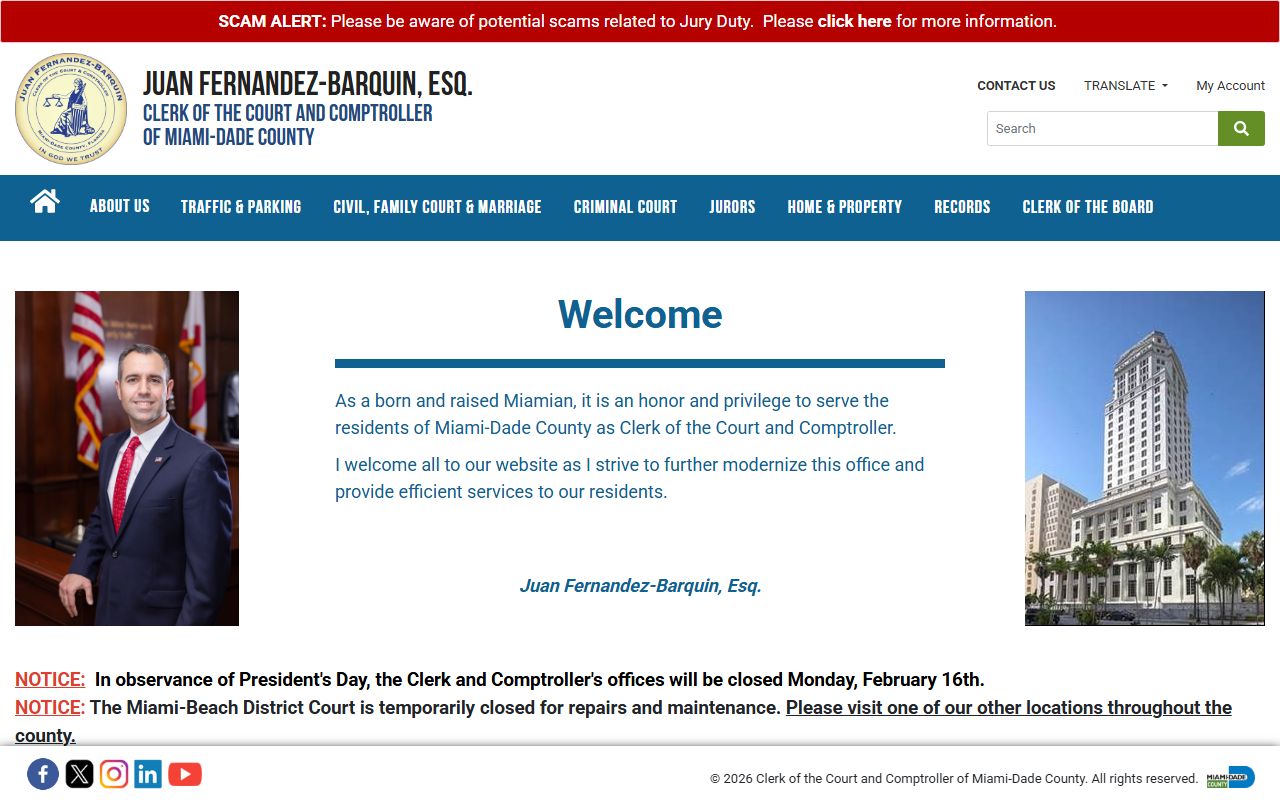
From the clerk homepage, you can reach the civil traffic infractions page, look up your citation, and find instructions for every option available to Miami residents dealing with traffic court cases.
Options After a Miami Traffic Ticket
You have 30 days from the date your Miami traffic citation was issued to pick how to handle it. This is not a suggestion. Missing this window brings extra fees and can lead to a license suspension. The Miami-Dade Clerk lays out your choices clearly on their site. Each one affects your Miami traffic court record in a different way.
The first option is to pay the fine. This counts as a guilty plea. Points go on your driving record, and the case closes. The second option is to pay and elect traffic school. You plead no contest, avoid points, and the court withholds adjudication. You do not appear in court for this one. Traffic school is not available for all violations, though. CDL holders, red light camera tickets, and tag or registration violations are excluded from the school option in Miami.
The third option is to plead not guilty and request a hearing. For citations issued in the last 30 days, you can submit this request online, by mail, by phone, or in person. If your Miami ticket is 31 to 180 days old, you pay a $16 late fee to get a court date set. Tickets older than 180 days need a motion filed with the administrative traffic judge. Under Florida Statute 318, penalties for infractions depend on the violation type and whether it is a first offense.
Note: Electing traffic school in Miami is limited to once every 12 months and five times in your lifetime.
Paying Miami Traffic Fines
Miami offers several ways to pay traffic fines. Online payment is the most common method. The clerk accepts Visa, MasterCard, Discover, and American Express through the traffic online payment system. You can also use PayFLClerk for Miami-Dade County traffic payments. Enter your citation number and pay right there.
Mail payments go to the Clerk of the Court and Comptroller, PO Box 19321, Miami, Florida 33101-9321. Send a check or money order. Include your citation number on the payment. Phone payments are also an option through the IVR system at 305-275-1111. In-person payments can be made at the Gerstein Justice Building.
If your Miami traffic fine goes unpaid past 90 days, it can end up with a collection agency under Florida Statute 28.246. The agency can add up to 40% on top of what you owe. The Miami-Dade Clerk also offers a traffic payment plan for people who need more time, as long as the citation has not already been sent to collections. Ask the clerk office about setting one up for your Miami traffic court case.
Public Access to Miami Traffic Court Records
Miami traffic court records are public under Florida Statute Chapter 119. Anyone can look up a traffic case. You do not have to be the driver on the ticket. The state's public records law says all government records are open for inspection and copying. Some personal info like social security numbers and bank accounts are kept out of public view, but the case details are accessible.
The Miami-Dade Clerk has been adding more records to their online systems. Adult traffic and criminal cases should be visible online according to state guidelines. This includes the content of actual court documents. If you need certified copies of a Miami traffic court record, those cost more than plain copies. The clerk office can tell you the current per-page rate when you call or visit.
Miami-Dade County Traffic Court Records
Miami is the county seat of Miami-Dade County. All traffic citations in the city go through the Miami-Dade County Clerk of Court. For more details about the county court system, full fee lists, and additional resources, visit the Miami-Dade County traffic court records page.
Nearby Cities in Miami-Dade County
Several other cities in Miami-Dade County also use the same clerk office for their traffic court records. Here are nearby cities with their own pages.